




Table of Contents
Table of Contents
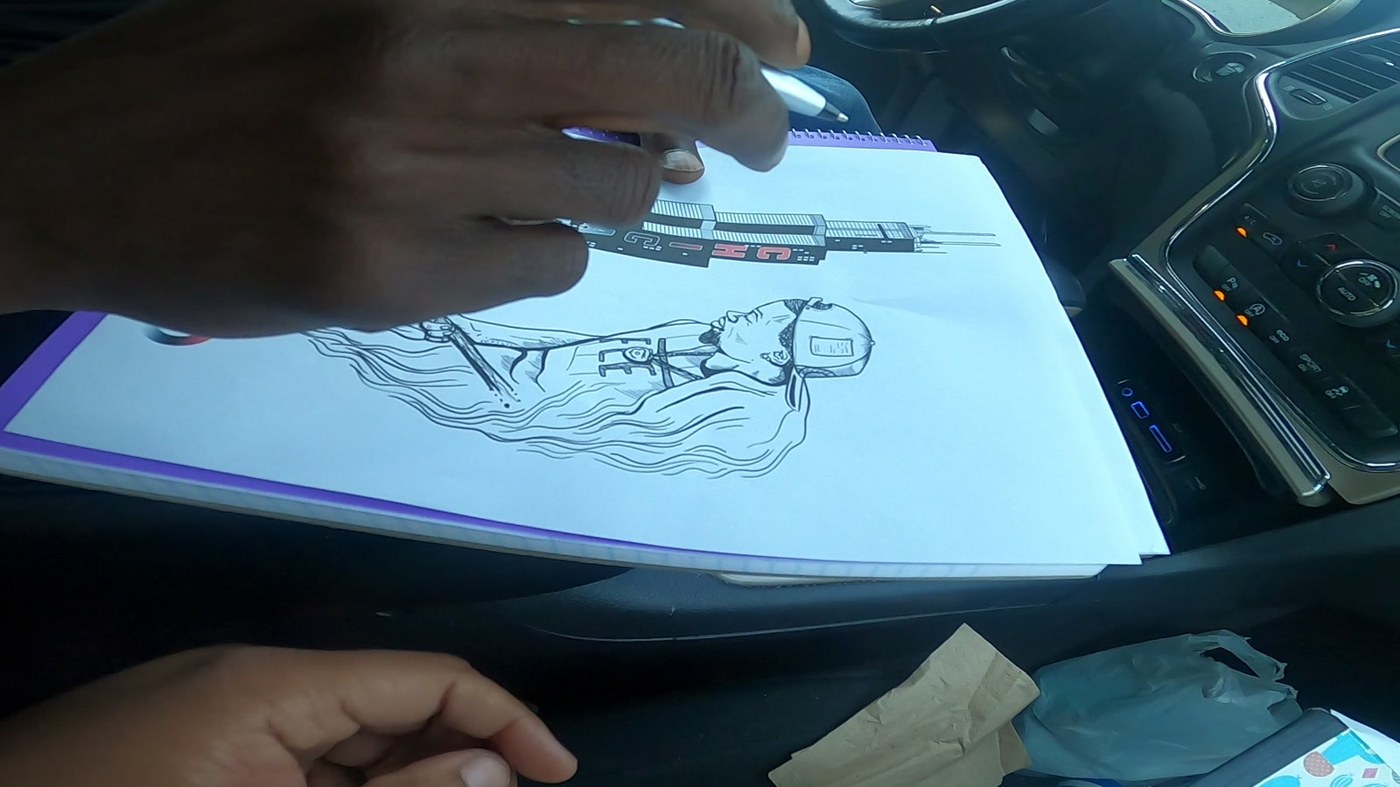
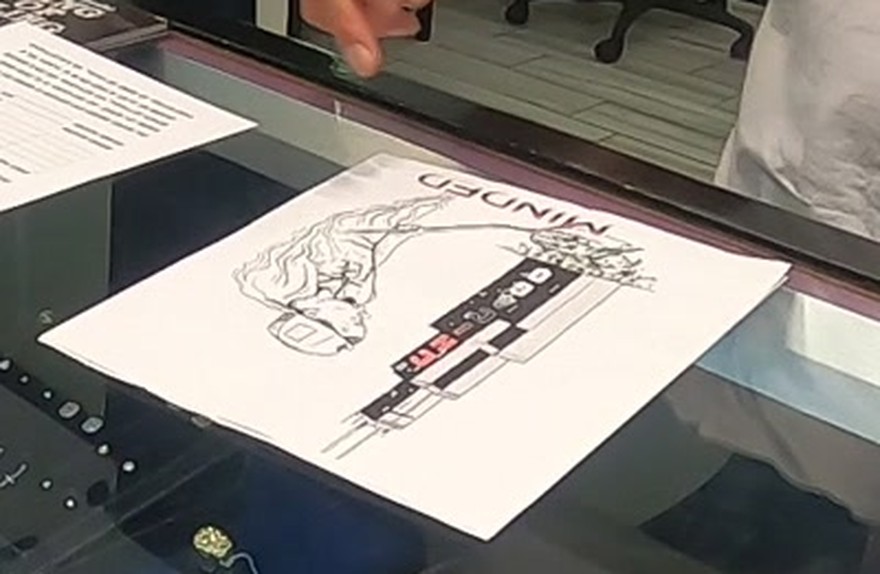
There’s a video on an old hard drive of me sitting in a car with a purple spiral notepad on my lap, drawing.
Not doodling. Drawing. A man with a shovel, bent into the work. A skyline running across the top. And one word underneath it.
MINDED.
That drawing is the reason this whole company has a name. And I want to walk you through what happened in that car, because this is the part most people skip, and then they wonder why their brand don’t mean nothing to nobody.
This ain’t a post about jewelry. It’s a post about custom chain design as a way of thinking, and what it costs you to actually finish an idea instead of buying one off a shelf.
Most people buy a logo. I built a sentence.
Here’s how it usually goes. Somebody decides they want a business. They go on one of them sites, type in their company name, and a computer spits out forty logos in about nine seconds. They scroll. They pick the one that look the cleanest. Maybe a swoosh. Maybe their initials in a circle. Maybe a mountain, because a mountain means you climbing something, supposedly.
Then they spend the next two years explaining what their company actually does, because the logo don’t say nothing. It’s decoration. It’s a sticker. It could belong to a moving company or a protein powder or a church.
A real mark ain’t decoration. It’s an argument you can see from across the room.
And the reason that matters ain’t aesthetics. It’s that you will not always be standing there to explain yourself. Your shirt gonna be on somebody in another state. Your page gonna load on a phone in a country you never been to. Your book gonna sit on a shelf between two books that ain’t yours. Whatever mark is on it has to carry the whole argument by itself.
Most people pick a logo. A logo is decoration. A mark is an argument you can see from across the room.
What’s actually on that piece of paper
Let me break the drawing down, because every piece of it is doing a job. Nothing on there is there because it looked nice.
The man with the shovel. He ain’t posing. He’s bent over, in it, working. That’s the first stage of everything I teach. Dig for the knowledge. Before you build a single thing you go down in the ground and get what you need, and digging is the part nobody claps for. There’s no audience at the dig. The audience shows up later.
The handle of that shovel is Chicago. Not the city as a place on a map. The city as the thing in my hand. Where I come from is the tool, not the destination. I live in Colorado now and Chicago is still what I’m holding when I work. That’s a different relationship to where you from than most people have. A lot of folks carry their city like a weight. I carry mine like equipment.
And then the word underneath it. MINDED.
That one word is doing triple duty, and this is the part I get animated about.
MINE. MIND. MINDED.
You MINE. M-I-N-E. You dig, you extract, you go down and pull something out that was already there waiting on somebody to come get it. That’s the work.
But the other meaning is sitting right there in the same four letters. Mine. What belongs to you. So the word is telling you what to do and what you get for doing it, at the same time. You mine for what’s mine.
You MIND. Mind your business. Pay attention. Stay on your own work and off everybody else’s. Don’t be out here commentating on other people’s dig sites while your own hole is three inches deep.
And here’s where it closes up on itself. Digging for what’s yours IS minding your business. They ain’t two instructions. They one instruction said two ways. The man who’s actually mining don’t have time to mind anything else, and the man who’s minding everything else ain’t mining nothing.
And that makes you MINDED. Not a guy who has a mindset. A guy who is minded. It’s a state, not a slogan.
That whole argument was on a notepad in a car before there was a website, before the book, before the store, before a single email subscriber. I didn’t write it out as a philosophy and then commission a picture of it. I drew the picture and found out later that I had already written the philosophy.
You mine with the shovel. You mind your business. Same instruction, said two ways.
That’s what a real mark does. It holds more than you put in it on purpose. You find things in it years later.
Why I drew it myself instead of ordering it
I could have described it to somebody. Paid a designer a couple hundred dollars, written four sentences in an email, got back a clean file in three days. Plenty of people do that and it works out fine for them.
I didn’t, and the reason ain’t pride. Here it is.
When you describe your idea to somebody else and they draw it, you find out later that you never actually finished thinking it. You had a feeling. They turned your feeling into a shape. The shape is clean and professional and it don’t mean anything to you, because you were never once forced to decide.
Drawing it yourself makes you decide.
How is he standing? Is he mid swing or is he resting on the handle? What’s he digging into, dirt or concrete? Does the skyline sit on top or run behind him? How big is the word compared to the man? Is the shovel bigger than him or is he bigger than the shovel?
Every single one of them questions is a question about what you actually believe, and a pen will not let you dodge a single one. You can be vague in a sentence. You cannot be vague in a line.
I’m not a professional artist and that drawing ain’t perfect. But every line in it is a decision I made on purpose, and four years later I can still tell you why each one is where it is. You can’t say that about a logo you picked off a menu.
Then I took the paper to a man who works in gold
There’s another clip of that same piece of paper sitting on a glass counter at a jeweler here in Denver. Mile High Jewelers. The man is standing across from me with a pen in his hand, looking down at my drawing, working out how to turn lines on a dollar store notepad into something you can wear on your neck.
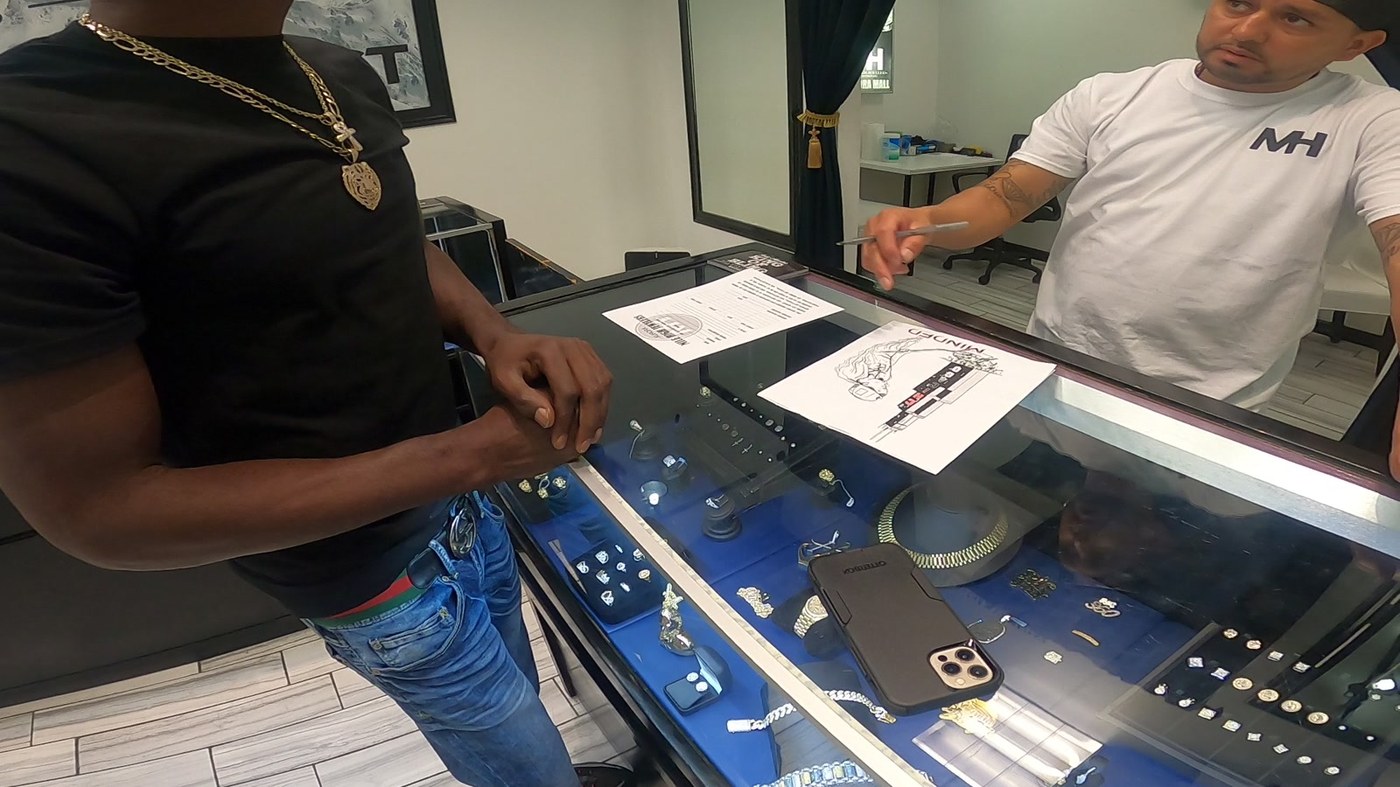
That’s the moment the idea stopped being mine alone. And I want to name something about how that conversation went, because it’s a business lesson that has nothing to do with jewelry.
I did not walk in there and ask what they had.
I walked in with a drawing. I already knew exactly what I wanted. The only thing I needed from that man was the part I genuinely could not do myself, which is turn a sketch into gold.
That is a completely different conversation than “show me what you got.” One of them you’re shopping. The other one you’re building, and you brought the plan with you.
Go into every room like that. The bank. The printer. The supplier. The lawyer. The web guy. The jeweler. Bring the drawing. You will be treated differently and you will get a better result, because the person across the counter can tell in ten seconds whether you know what you want or whether you came to be sold something.
What a mark has to do when you’re not in the room
Here’s the test I’d put on anything you make.
Can it work with the sound off?
A swoosh can’t. Your initials in a circle can’t. A generic mountain can’t, because a mountain belongs to everybody and therefore to nobody.
But a man digging, with a shovel made out of the place he’s from, under a word that means both mine and mind at the same time? That works. Somebody who never heard of me can look at it and get most of the way there without me saying a word.
That’s the bar. Not “does it look professional.” Does it say the thing when I’m not there to say it.
I made the same argument about nobody searching your name, and it’s the same idea from a different angle. People don’t come looking for you. They come looking for their problem. Your mark, your title, your page, all of it has to meet them where they already are, without a introduction.
You won’t always be in the room. Whatever you put on it has to carry the argument without you.
This ain’t a chain, but this is a business plan
So here’s the turn.
This ain’t a chain, but this is a business plan.
Everything this company has done since came out of that piece of paper. Dig. Build. Grow. was already sitting in it. The shovel is the dig. The making of the piece was the build. Everything after it is the grow.
In that order.
That’s the same argument behind having a hustle instead of a business and the same one behind posting every day and owning nothing. Different rooms, same concrete. Effort ain’t what’s missing for most people. Direction is. And a mark that means something is direction you can hold in your hand.
Here’s the clip of it happening. No edit, no music, just a pen and a notepad in a car:
Four years on a thumb drive
Now here’s the part that stings a little, and I’d rather say it than leave it out.
That footage sat on a USB stick in a pile with a bunch of other sticks for four years. I didn’t know what was on half of them. Some of them don’t even work anymore. I had to go through the whole pile recently just to find out what I still had.
I documented the single most important day in this company’s history and then I lost it in a drawer.
That ain’t a humble brag. That’s a real mistake and a whole lot of you are making it right now. You’re building things and not keeping them. The photo, the first ugly draft, the voice memo, the receipt, the napkin, the drawing. You think you’ll remember. You won’t. Four years is longer than it sounds.
Keep your stuff. Put it somewhere it won’t die, and put it in two places, because one place is not a place. The story of how you built it is an asset, and one day you’re going to want to tell it, and you’ll be standing there with nothing to show but your word.
I got lucky. That stick still worked.
If you’re about to make yours
One. Draw it yourself first. Even if you can’t draw. Especially if you can’t draw. You’re not making art, you’re making decisions. Hand the mess to a professional afterward and let them clean it up. The mess is the valuable part.
Two. Make sure the mark says the thing. Not “looks cool.” Says the thing. If you can’t explain in one sentence what your mark argues, it argues nothing. Write that sentence down before you draw anything.
Three. Check nobody else owns it. Before you fall in love with a name or a mark, run it through the federal trademark database. It’s free and it takes ten minutes. Finding out somebody already owns your idea after you put it on five hundred shirts is an expensive way to learn.
Four. Walk in with the drawing. Whoever you’re hiring, whatever you’re buying, bring the plan. Different conversation, better price, better result.
Five. Keep the evidence. Photograph the process. Save the first ugly version. You are not documenting for today. You’re documenting for the version of you four years down the road who’s looking for proof that it was real.
The close
I still wear it.
Every once in a while somebody asks me about it, and they’re expecting me to tell them what it cost. Nobody ever asks what it means. That’s alright, because I know, and it wasn’t made for them to know.
A man digging. A shovel with Chicago on it. One word that tells you to go get yours and mind yours in the same breath.
I drew that in a car, on a notepad I probably got from a dollar store, with a pen I probably borrowed.
If you want the long version of what those three words actually ask of you, it is all in Dig. Build. Grow. That is the blueprint this drawing is a picture of.
Dig for the knowledge. Build something real with it. Grow into the life you actually wanted. In that order.
Keep it solid.