






Everybody wants the magic prompt. The one paragraph you paste in that makes the machine finally get it.
There ain’t one. I’ve looked.
What there is, is something less exciting and a lot more useful: you write down how you actually think, once, in plain language, and then you stop having to explain yourself. Not a prompt. A record of your judgment.
And here’s the part that surprised me. Doing that made me better at my own business, before any machine touched it.
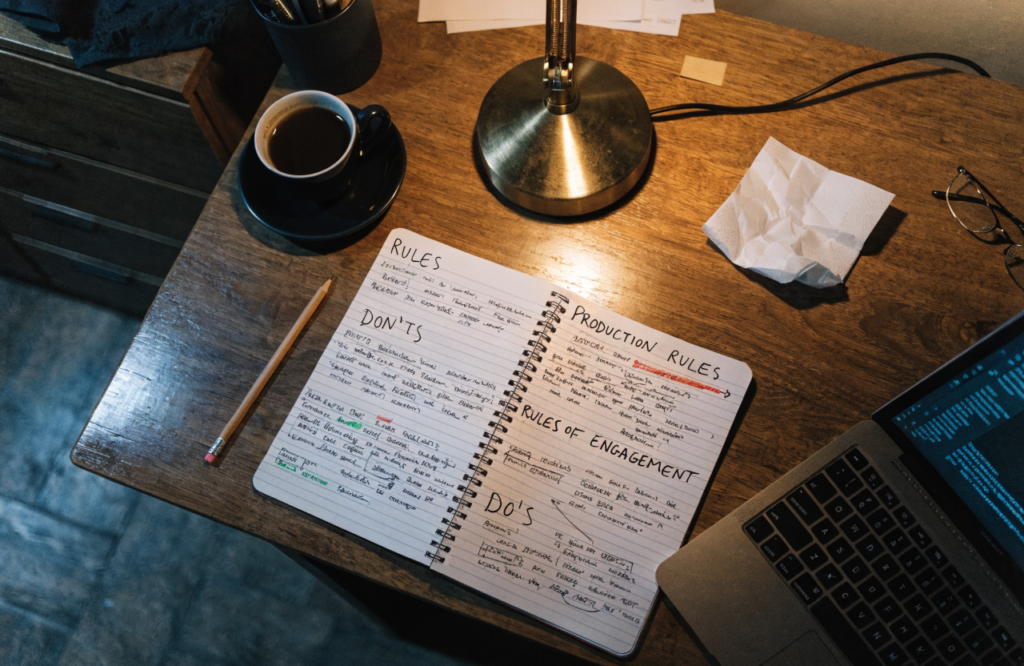
A prompt is a request. A system is a standard.
When you type a prompt, you’re asking for one thing, one time. Tomorrow you’ll ask again, slightly different, and get something slightly different, and spend the rest of the day nudging it back toward what you meant.
That’s not a tool problem. That’s you re-deciding the same thing every single day.
A standard ends that. Written once: this is how long a post runs, this is the voice, these words never appear, this is what has to be true before anything publishes. Now the machine isn’t guessing at your taste. It’s reading it.
And so is anybody else you ever hand the work to. That’s the part people missthe same document that teaches a machine teaches a person. You didn’t build an AI system. You built the thing you’d need anyway the day you hire somebody.
Start with what you refuse to do
Most people start by describing what they want. Start with the opposite. It’s faster and it’s sharper.
What do you never say? What headline would you be embarrassed to publish? What claim won’t you make even if it’d sell? What words aren’t yours?
I can tell you mine without thinking: no fake statistics, no invented quotes, no fear tactics, no clickbait, no talking down to people about money or prison or starting over. Nothing religious dressed up as spiritual. And nobody corrects my grammar into somebody else’sthe way I talk is deliberate, and a system that sands it smooth has broken the one thing that makes it mine.
Write your refusals first. They’re the sharpest thing you own and they take five minutes, because you already know them. You’ve just never said them out loud.
Then write down the thing you keep explaining
Here’s the tell for what belongs in the system: anything you’ve explained more than twice is a document you haven’t written yet.
Anything you've explained more than twice is a document you haven't written yet.
Every time you correct the same mistake, that’s a missing rule. Every time you rewrite the same section, that’s a missing standard. Every time you think “no, not like that”. That’s the system asking to be built.
Don’t write it as theory. Write it as the correction. “Not 1,200 words padded out. 2,000 words earned.” That sentence does more work than a page about quality, because it’s specific enough to fail against.
A rule you can’t fail is a slogan.
Teach it the way you’d teach a person
That video is me explaining business fundamentals, assets, liabilities, multiple income streams, by putting them next to something the listener already understands. That’s the whole method. You explain the unfamiliar thing through the familiar one.
Same move works here. When you’re teaching a system your judgment, don’t write abstractions. Write examples with the wrong version next to the right one. This is weak. This is strong. Here’s why.
Machines learn the same way people do. From contrast, not from adjectives. “Be engaging” teaches nothing. Two paragraphs side by side, one working and one not, teaches everything.

Break it into jobs, not one big brain
The instinct is to build one system that does everything. Don’t. It gets vague, and vague is where quality goes to die.
Break it by job, the way you’d staff a real operation. Something that decides what to make. Something that makes it. Something that checks it before it goes out. Something that reads the numbers afterward and says what worked.
That last one is the one everybody skips, and skipping it is why people produce forever and never improve. A system with no checker is just a faster way to be wrong. Ask me how I know. I’ve broken my own pages doing work I was certain about, and the only reason I caught it was going back to look.
A system with no checker is just a faster way to be wrong.
The check don’t have to be sophisticated. Mine is mostly: did I verify what I might have broken, or only what I built? Those are different questions and the second one feels like enough right up until it isn’t.
The part nobody warns you about: it’ll agree with you
This is the real risk and I want it said plainly.
A system built from your own thinking will reflect your own thinking back at youincluding the parts that are wrong. It’ll be confident. It’ll be fast. It’ll be agreeable. And a fast confident agreeable thing that shares your blind spots is not an assistant, it’s an echo.
So build the disagreement in on purpose. Somewhere in your rules, in writing: challenge weak ideas, name the risk, say when I’m wrong and offer the better version.
I mean it literally. Put it in the document. Because a system that only complies will happily help you do the wrong thing beautifully, at scale, for months. The most valuable thing any of this has ever done for me is tell me no.
The most valuable thing any of this has ever done for me is tell me no.
What this actually looks like in practice
Not glamorous. A folder of plain documents.
One says who I am and what the business is for. One says how I write. My rhythm, my refusals, what to never smooth over. One says what a finished piece of work has to contain before it counts as finished. One holds the real details of my life so nothing gets invented about me. And one is a running record of every mistake made and the rule that came out of it.
That last one is the most valuable document I have. Every entry in it cost something. Every entry means that particular mistake has a fence around it now.
Because that’s the actual compounding asset here. Not the output. Anybody can generate output. The asset is a set of standards that got sharper every time something went wrong. Tools change. Models change. What you learned about your own work doesn’t.
Say it so it can be repeated
There’s a test I use on a job site that turns out to work on everything: can the other person repeat it back to somebody else without you in the room?
If they can’t, you didn’t communicate. You performed near them. I wrote the long version of that in why saying it ain’t the same as it landing, and it turns out to be the exact standard for a written rule too.
Read your rule back and ask whether somebody who’s never met you could apply it and get the thing you wanted. “Keep it professional” fails. “No exclamation points, no emoji, contractions are fine” passes. One is a feeling. The other one is executable.
Most people’s standards are feelings. That’s why they have to keep supervising.
The document nobody writes: what’s actually true about you
This one’s boring and it’s the one that prevents the worst mistakes.
Somewhere in your system, write down the plain facts. What you actually do for a living. What you’ve actually built. What you’ve actually been through, and what you’re willing to say about it publicly. The names, the numbers, the dates that are real.
Because anything you don’t write down, a system will fill in. Not maliciously. It’ll just reach for the shape that usually goes there. And the shape that usually goes there is a cliché about somebody who isn’t you.
I’ve watched it happen. A detail about my life gets slightly rounded off, a job title gets inflated because it sounded better, a story picks up the ending that stories like that usually have. Every one of those was somebody guessing where the record was silent.
The fix is unglamorous: write the true version down, in boring detail, before anybody needs it. It’s the cheapest insurance in the whole build.
Then go back and audit what it produced
Building the system is the fun part. Checking it is the part that decides whether it was worth building.
Once a month, go read something it produced when you weren’t watching closely. Not to admire it. To find where your standard was too loose. Every place you wince is a rule that needs a sentence.
That’s the same muscle as the audit that stops you repeating yourself, just pointed at your output instead of your life. And it works the same way: the story you tell yourself about how it’s going is not the same as going and looking.
Most people build a system, feel accomplished, and never open the trunk again. Then a year later they wonder why everything sounds slightly off. It’s been drifting the whole time and nobody was reading.
Why this matters more than the tool you pick
People spend weeks choosing between platforms and about nine minutes deciding what good looks like.
Then they wonder why the output feels generic. It feels generic because generic is what you asked for. You gave it no taste to work from, so it used everybody’s.
The tools will keep changing. That’s guaranteed, and it’s fine. What you write down about how you think travels with you to whatever comes next. It’s portable in a way no subscription is.
I broke down the structure I use for that in the six layers I stack before I ask AI for anything, and the reason it works ain’t clever prompting. It’s that each layer is a decision I already made on paper, so I’m not making it again at midnight.
Start smaller than you think
Don’t go build a whole operating manual this weekend. You’ll write theory, and theory is worthless here.
Pick the one thing you produce most often. Write down three rules it has to satisfy and two things it must never do. Five lines. Use them for a week. Every time you find yourself correcting something, that correction is line six.
In a month you’ll have something real, built out of actual friction instead of imagination. That’s the only way it ever gets built.
And the payoff ain’t really the machine. It’s that you finally know what you think. Most people are carrying their standards around in their head, slightly different every day, arguing with themselves about work they already decided how to do.
Dig for what you actually believe about your work. Build the document that holds it. Grow into somebody whose standards don’t move depending on how tired they are.
The machine’s just the first thing that reads it.
3 Responses